
· by Michael Blair, Nashville's Water Damage
When water gets across a floor, from a burst supply line, an overflowing appliance or a slow leak found weeks late, the first question after stopping the water is whether the floor can be saved. The answer depends on what the floor is made of, how long it was wet, whether the water was clean, and what is underneath it. A restoration company makes that call in the first hour, and knowing how they make it tells you whether the floor is worth fighting for.
Solid hardwood: often savable if drying starts fast
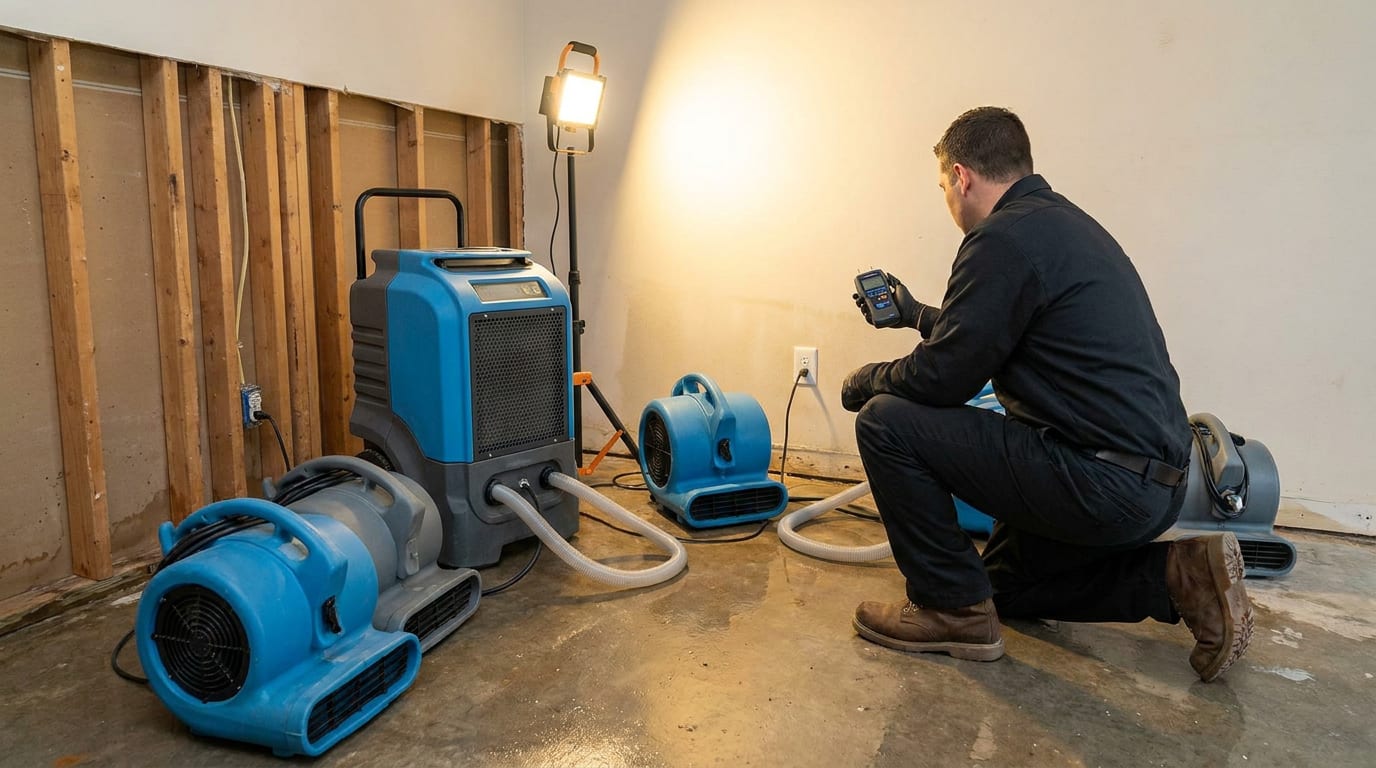
Solid wood takes on water slowly and gives it up slowly. Boards cup within a day or two as the underside absorbs more than the top, and if drying starts before they buckle, specialized floor-drying mats pull moisture out through the boards over one to two weeks, and the cupping often relaxes as the wood equalizes. A moisture meter tracks progress; the floor is dry when it matches the boards in an unaffected room.
It fails when water sat for days before anyone acted, when the boards have buckled up off the subfloor, or when it was black water. A floor that has cupped badly can sometimes be sanded flat after it has fully dried, months later, and only if it has enough thickness left. Drying too fast, with heat alone, splits it.
Engineered, laminate and vinyl
Engineered hardwood has a thin real wood layer over plywood or fiberboard. Plywood-core products behave a little like solid wood and can sometimes be dried; fiberboard-core products swell and do not come back. Laminate is a photograph on a fiberboard core, and a wet fiberboard core swells at every edge and stays swollen. Laminate that has been wet more than briefly is replaced, not dried, and it usually holds water against the subfloor while it does it.
Luxury vinyl plank does not absorb water itself, which is its selling point, but it traps water underneath, and the subfloor below a wet vinyl floor can be soaked and growing mold while the surface looks fine. A glued-down vinyl floor after a flood is usually pulled so the subfloor can be dried; a floating vinyl floor can sometimes be lifted, the subfloor dried, and the planks relaid.
- Solid hardwood: dry in place if caught within a day or two
- Plywood-core engineered: sometimes; fiberboard-core: no
- Laminate: replace
- Vinyl plank: the subfloor under it is the question
- Carpet: pad replaced, carpet sometimes saved if clean water
Carpet, tile and the subfloor
Carpet over pad can often be saved after a clean-water loss if it is extracted and dried quickly, but the pad underneath almost never is; it is a sponge, it is cheap, and it is replaced. Gray or black water means the carpet goes as well. Tile is unbothered by water on its surface but the subfloor beneath it is not, and a tile floor over a wet wood subfloor is a difficult case, because the tile has to come up to dry what is underneath.
The subfloor decides the outcome for every floor type. Plywood dries; oriented strand board swells and loses strength when saturated, and particleboard underlayment, common under older vinyl and carpet, dissolves into mush and is always replaced. On a crawl space house the water also went down through the subfloor into the insulation and onto the ground, and that has to be dried too.
What decides it in practice
Time is the largest factor. Water found within hours, on a solid or well-built floor, is a drying job. Water found after a weekend away is usually a replacement, not because the material could not have been dried but because mold growth begins within a couple of days in Nashville humidity, and a floor that has started to grow mold is removed. The category of water is the second factor: anything from a toilet, a sewer or outdoors is not dried in place regardless of the material.
A restoration company documents moisture readings, the water category and the material, and that documentation is what an insurance claim runs on. If a floor is being replaced, the readings are the justification; if it is being dried, the readings are the proof it is dry. Either way, ask for them.