
· by Michael Blair, Nashville's Water Damage
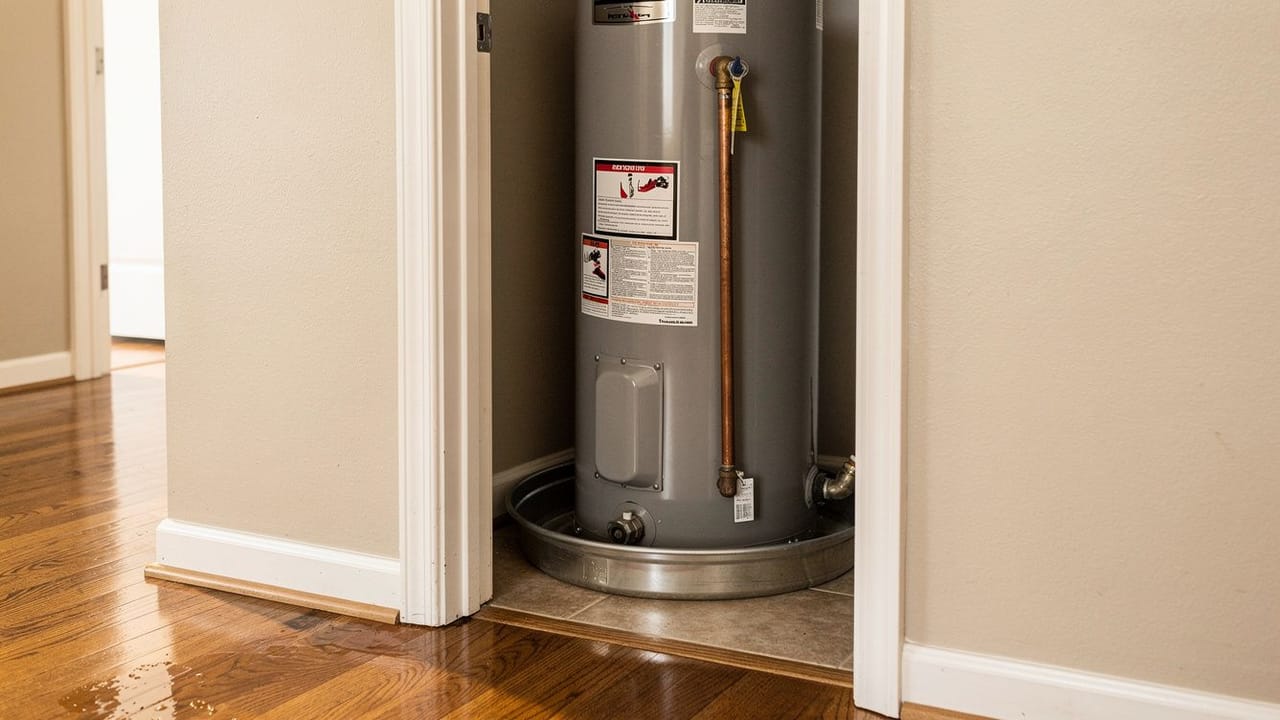
A. O. Smith says it plainly in its installation manual: all water heaters eventually leak. When the tank sits in a hall closet over hardwood, in a utility room above a finished basement or on an upper floor, the difference between a wet pan and a soaked subfloor is a shallow tray of metal and a drain line that actually goes somewhere. This post covers that pan and the pipes around it, under the model residential code Tennessee has adopted. If water is already on the floor, the steps in the first hour after a pipe lets go apply here too.
When does the code call for a pan under the heater?
Whenever a leak from the tank would damage the house. Section P2801.6 of the Tennessee Residential Code, the model International Residential Code with the state’s amendments, says a tank-type heater in that kind of location goes in a pan. Over a finished floor, above a ceiling or in a closet off a carpeted hall, that is not a close call.
The code sets what the pan is made of: galvanized steel or aluminum at least 0.0236 inch thick, plastic at least 0.036 inch thick, or another approved material. A plastic pan under a gas-fired heater also has to meet a flame-spread rating of 25 or less and a smoke-developed rating of 450 or less.
Code editions change, and the local codes office decides which one a permit falls under. Metro Codes, or the codes office in your county, can tell you which edition applies to a new installation at your address.
How deep should the pan be, and where does it drain?
At least 1-1/2 inches deep, drained through a pipe of at least 3/4 inch that runs full size to a proper end point. Section P2801.6.1 sets those minimums and requires the pan to be big enough to catch drips or condensate from the tank. Section P2801.6.2 says the drain either ends over an indirect waste receptor or runs to the outside of the house and stops 6 to 24 inches above the ground.
The maker asks for a little more. A. O. Smith’s installation instructions and use and care guide says a metal pan should go under the heater in all cases, at least an inch larger than the jacket at every point, no more than 1-3/4 inches deep, and piped to an adequate drain. It also points to leak detectors and water shut-off devices, used with a piped pan, as a way to limit damage from a leak nobody is home to see.
One gap catches people. When a heater is replaced where no pan drain existed before, the code does not require one to be added. A pan with no drain still catches a slow drip, but in a real failure it fills and spills over, so on a closet or upper-floor heater we think the drain line is worth running even where it is optional.
Where should the relief valve pipe end?
In open air, in the same room as the heater, where someone will see it. Section P2804.6.1 sets the rules for the pipe from the temperature and pressure relief valve: it cannot connect directly to the drainage system, it discharges through an air gap, it is no smaller than the valve outlet, it carries no valves or tees and no threaded end, it flows by gravity, and it stops no more than 6 inches above the floor or the receptor.
The same section allows it to discharge to the floor, into the heater’s pan, to a waste receptor or outdoors, in a way that will not hurt anyone or damage the structure. A relief valve that opens is a warning about temperature or pressure in the tank, and the code wants that warning where the people in the house can notice it.
A. O. Smith’s guide also advises against putting a water heater in an attic or on an upper floor. Where one is already up there, the pan, its drain and the relief line are doing all the work of keeping a failure from coming through the ceiling below, the same way the ceiling stain under an attic AC unit starts.
A four-point check of your own water heater
Look at the base of the tank while it is still dry; the questions below cover most of it. If a heater has already let go, the water can run under the closet wall into the subfloor and the next room before it shows. Our water extraction crews pull the standing water and then measure what the floor and walls took on. We work across Nashville and the counties around it, and you can reach us here with where the heater sits in the house.
- Is there a pan under the tank, and is it metal or plastic?
- Does a pipe leave the pan, and can you follow it to a drain or to the outside wall?
- Does the relief valve pipe end in open air near the floor or over the pan, rather than tied into a drain line?
- Is the heater over a finished floor or above a ceiling, where a failure would travel?
Sources
- Tennessee Residential Code, Chapter 28 Water Heaters, Sections P2801.6, P2801.6.1, P2801.6.2 and P2804.6.1 (via UpCodes) — Pan required where leakage will cause damage; pan materials and thicknesses; plastic pan ratings under gas heaters; 1-1/2 inch depth and 3/4 inch drain; no drain required for a replacement where none existed; drain termination; relief valve discharge pipe rules.
- A. O. Smith, Installation Instructions and Use and Care Guide, Residential Gas Water Heaters — All water heaters eventually leak; metal drain pan in all cases, one inch larger than the jacket, maximum 1.75 inches deep, piped to an adequate drain; leak detectors and shut-off devices; not advisable to install in an attic or upper floor.
FAQ
Water Heater Leaks and the Drain Pan Under It — questions
What size drain pan for a water heater?
Under the residential code, at least 1-1/2 inches deep and large enough to catch drips from the tank. A. O. Smith asks for a metal pan at least one inch larger than the heater’s jacket at every point and no deeper than 1-3/4 inches. The drain pipe from it has to be at least 3/4 inch.
Can a water heater relief valve drain into the pan?
Yes. Section P2804.6.1 of the residential code allows the relief valve pipe to discharge to the floor, into the pan serving the heater, to a waste receptor or outdoors. It must end through an air gap in the same room, flow by gravity and stop no more than 6 inches above the floor or receptor.
Is a drain pan required when replacing a water heater?
The pan rule applies wherever a leak would cause damage, replacement or not. The code does relax one thing: if no pan drain was installed before, a replacement heater does not have to get one. A pan without a drain still overflows in a real failure, so a drain line is worth adding where it can be run.
Can a plastic drain pan go under a gas water heater?
Yes, if it meets the code. A plastic pan has to be at least 0.036 inch thick, and under a gas-fired heater its material has to meet two fire ratings, flame spread no higher than 25 and smoke developed no higher than 450. A. O. Smith’s own instructions call for a metal pan in every case.