
· by Michael Blair, Nashville's Water Damage
Most people picture water extraction as a big vacuum and a few fans, and the vacuum is the shortest part of the job. It matters more than its length suggests, because water pulled out as liquid never has to be dried out of the house as vapor. The rest of the job is finding where the water went, measuring it, deciding what stays and what comes out, and drying to a number instead of a feeling. This is the work behind our water extraction service, in the order it happens in a house.
Pumps, truck mounts and weighted passes
Water standing deeper than the floor can hold, in a basement or a sunken den on a slab, goes out first with a submersible pump and a discharge hose run outside or to a drain. Once it is down to what the materials are holding, the extractors take over. A truck-mounted unit runs off the van and has the strongest vacuum, with hoses run into the house. A portable extractor is carried in and plugs into the wall, and it is what we use on a second floor, in a condo, or anywhere a hose from the street cannot reach.
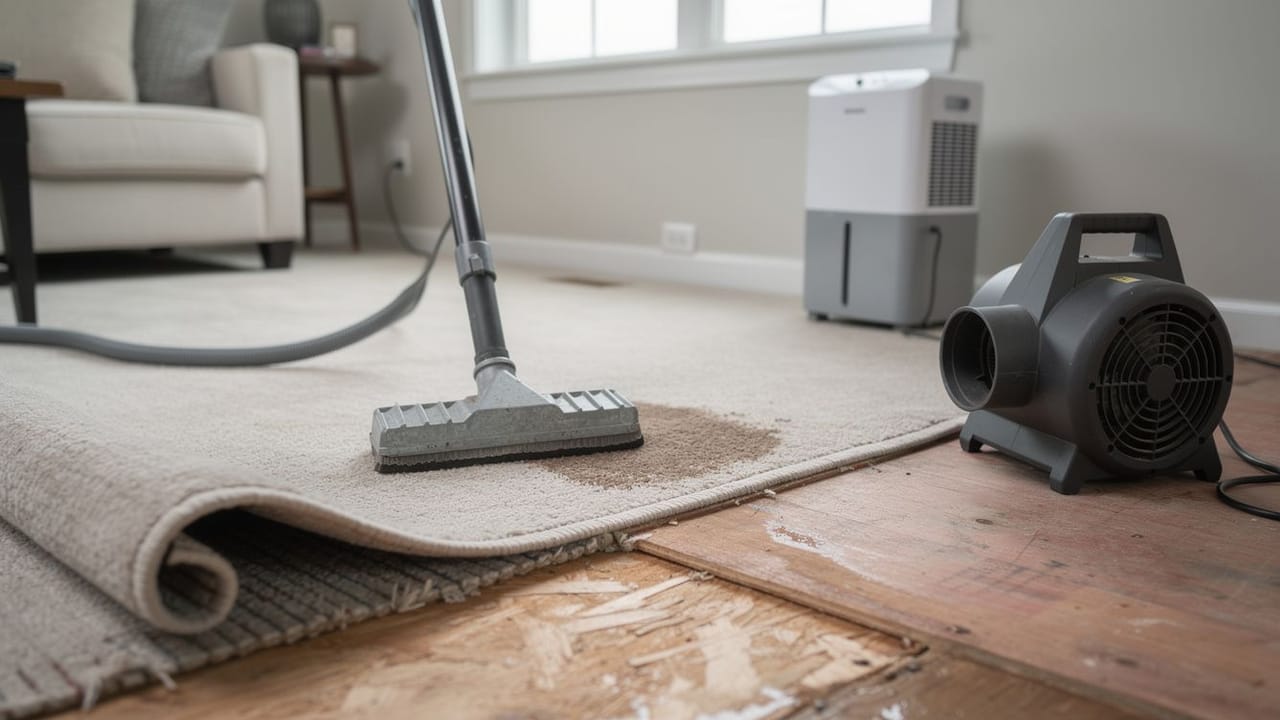
The EPA’s table on water damage cleanup and mold prevention lays out the same three steps for wet carpet: remove the water with a water extraction vacuum, bring the humidity down with a dehumidifier, and speed the drying with fans. It also says the subfloor under the carpet has to be cleaned and dried, and that is where most of the real work sits.
On carpet, a hand wand only pulls from the top. Weighted extraction uses a tool the technician stands on, so body weight presses the carpet and pad flat and forces water up into the vacuum. It is rolled slowly across the room in overlapping passes, and we keep going until a pass brings up almost nothing. On a carpet whose pad is staying, those passes are what make drying it in place possible.
Meters and the moisture map
Before and after extraction, the wet area is measured, not judged by touch. Two kinds of meter do that. As Delmhorst’s guide to pin and pinless moisture meters explains, a pin meter reads the electrical conductivity of wood or another material that holds moisture, while a pinless meter uses radio frequency and impedance to read below the surface without a hole, needs its pad flat against the material, and gives a relative reading. We sweep floors and walls with the pinless meter to find the edge of the water fast, then use pins where we need a number.
Those readings go on a moisture map: a sketch of the affected rooms with every reading spot marked and numbered, plus a reading from a dry, unaffected area of the same material. That dry reading is the target. The Restoration Industry Association’s tips on moisture meter use in water mitigation ties the meter’s job to drying goals based on dry standards, and it points out that calibration differs from one instrument to the next. So the same meter goes back to the same spots for the whole job.
Water travels further than the stain on the carpet. It wicks under baseboards, into the bottom of drywall and across into the next room’s pad. The map is how that hidden edge gets found on the first day, while it is still easy to dry.
The pad, the baseboards and what comes out
Carpet pad is a sponge lying flat against the subfloor. Whether it stays depends on where the water came from and how long it sat. Our practice is to pull pad that took anything other than clean water, or that has been wet for a while, because new pad costs little and wet pad keeps feeding water into the floor under it. The pad is cut out in sections, and the carpet is released from the tack strip and folded back or lifted so air can reach the subfloor. How each type of floor is judged is in our post on which wet floors can be dried and which cannot.
Where the wall readings come back wet, baseboards come off, and where the readings call for it, small holes go into the drywall behind where the baseboard sat, so air can get into the wall cavity and the holes are hidden once the trim goes back. In a lot of Middle Tennessee houses the carpet sits on a wood subfloor over a vented crawl space, so we read the floor from the crawl space too when we can get under it.
Anything removed is photographed in place and measured before it leaves. The Insurance Information Institute’s advice on filing a homeowners claim says to avoid throwing out damaged items until the adjuster has visited where possible, so when an adjuster wants to see the pad or a cut of drywall, we hold it.
Drying equipment, daily readings and the claim record
With the water out, air movers push air across the wet surfaces so the moisture evaporates, and dehumidifiers pull that moisture out of the air before it settles back into the drywall. Through a Nashville summer the outdoor air is heavy with moisture, so the house stays closed and the dehumidifiers do the work; opening windows on a muggy day adds water. The science behind it is psychrometry, which the IICRC S500 standard for professional water damage restoration, in its fifth edition from 2021, lists among the topics it covers. The EPA’s brief guide to mold and moisture in the home says to dry water-damaged areas and items within 24 to 48 hours to prevent mold growth, which is why extraction comes first and the equipment is set the same visit.
The drying goal is simple to state: every point on the map reads at or near the dry reading for its material. Each day we take readings at the same points, at about the same time of day as the RIA guidance recommends, and move or pull equipment as areas reach the goal. Drying ends when the map says so, not on a set day.
All of it is written down, because the adjuster was not there. The Insurance Information Institute tells homeowners to photograph the damage, take reasonable steps to protect the property, and save receipts. Extraction is that reasonable step, and the record we keep is what our insurance coordination work hands to the adjuster.
- Photos of the water before extraction and of each room as it was opened up
- The moisture map, with the dry reading for each material
- Each day’s readings, point by point
- Every air mover and dehumidifier, where it sat and how many days it ran
- What was removed, how much, and why
Sources
- U.S. EPA, Mold Remediation in Schools and Commercial Buildings, Chapter 4, Table 1 — Wet carpet: extraction vacuum, dehumidifier, fans; subfloor under carpet cleaned and dried.
- Delmhorst Instrument Co., Pin or Pinless Moisture Meters — How pin and pinless meters read moisture.
- Restoration Industry Association, Top Tips for Moisture Meter Use in Water Mitigation — Drying goals based on dry standards; daily readings at the same spots and time; calibration differs between meters.
- IICRC, ANSI/IICRC S500 Standard for Professional Water Damage Restoration — Fifth edition, 2021; psychrometry and drying technology among its topics.
- U.S. EPA, A Brief Guide to Mold, Moisture and Your Home — Dry water-damaged areas and items within 24 to 48 hours to prevent mold growth.
- Insurance Information Institute, How to File a Homeowners Claim — Photograph damage, protect the property, keep damaged items for the adjuster, save receipts.